I started this year excited to continue working on CARCAS, an archaeology project about displaying 3D scans of animal bones. I am now graduating, and looking back on the work I have done, I am incredibly proud of the technologies I have learned, the technical documentation I have written, and my growth as a team leader.
This winter, with the addition of the Alpaca skeleton, it became clear that the current systems in place for storing the CARCAS models on the web server were no longer sustainable. There were too many big files, and the method for storing them took up too much additional space.
The transition took a lot of time and effort. I started by researching different tools, eventually settling on Datalad since it has clear, beginner friendly documentation and it can play nice with the web server that CARCAS already used. Figuring out the correct configuration tested my patience. My early attempts at making the models downloadable caused a nasty little bug that prevented the correct method from working. I tried troubleshooting on the Datalad forum, but even experienced users couldn’t figure out how to fix it. I finally started over from scratch, and everything worked like a charm.
Dealing with this bug, and solving it by starting from scratch, reinforced that failing is part of the learning process. The second time around, everything went a lot smoother because I understood how all the pieces fit together. And, I was able to write down what I was doing because I wasn’t overwhelmed with learning new things.
Once the new system was in place, my supervisors emphasized that I needed to write instructions so that future DHAs could learn how to use it. After all, a system for collaboration and backups is useless if no one knows how to use it. I thought this would be relatively straightforward. After all, I knew how to use the system and I didn’t have comprehensive notes of my own.
I discovered that I had learned a lot through experimenting with Datalad and the new CARCAS system, and that it was not immediately obvious to others what to do. I collaborated with Noah Zameer Lee, another DHA. He had completed the Datalad tutorial like I had, but he had been working on other projects while I set up the new system. When I was sitting right next to him, I could guide him through using the system, but there was a lot that was not clear, even to someone familiar with the software.
I wrote a few different sets of instructions and documentation for different use cases. I focused especially on first time set up, routine tasks, and where to learn more to deeply understand the tools. These were the areas that overwhelmed me when I first started working on CARCAS. First time set up and routine tasks look easy when you have done them before, but when you are just getting started, there’s nothing for your brain to latch on to.
Also, towards the end of making it easy for a future DHA to get started, I hosted a recorded Zoom meeting with my supervisors and coworkers where I demonstrated what it looks like to follow my instructions and start making changes. I deliberately chose to record this video from a new account on my computer so that I would have to show the set up.
Recording this walk through was also incredibly helpful for me. I discovered tasks that I had forgotten to write about because they had become second nature, and I discovered sections of my documentation that were too cluttered and difficult to reference. Just as revising is helpful when writing an essay or a blog post, I learned that it is also an essential step of writing technical documentation.
Working on CARCAS’s back-end transition has taught me a lot about working as a team leader. I made impactful decisions, like when I decided that Datalad was the best tool for CARCAS. I had to reassess and choose whether or not to stand by my decisions, like when I spent weeks looking for the bug in my first attempt at using Datalad. I needed strong communication throughout the whole process. I explained to my supervisors what I was doing and why, without getting into the technical weeds. I taught Noah how to use the system I set up, and I helped him figure out how it fit in with his piece of the project. I created documentation and a video for future DHAs, in hopes that I could pass on my knowledge.
I have had a wonderful time working on CARCAS this year. As I go off into the world after Carleton, I can’t wait to look back and see how CARCAS keeps on growing!
In previous blogs, I have discussed how Gale Digital Scholar Lab (GDSL) can be utilized to create datasets and subsequently conduct various analyses on them. Recently, a comparable online ‘data lab’ has emerged as a contender: JSTOR’s Constellate. Much like GDSL, Constellate is an online platform, developed by JSTOR, designed to support digital scholarship by providing tools for text and data mining across a broad range of academic content. Researchers, data scientists, and advanced students can utilize Constellate to analyze and explore diverse datasets, conduct advanced text analysis, and gain insights from academic texts. The platform offers a suite of tools for tasks like clustering, n-grams, and topic modeling, and integrates with Jupyter Notebooks for users who prefer coding in Python or R.
In this blog, I intend to explore the distinctions between Constellate and GDSL, highlighting how each platform may be better suited for different purposes. I will assess them based on various criteria, including the quality of the database, access to full-text content, user-friendliness, and flexibility.
1. Quality of Database:
Both tools provide researchers with access to a database containing a wealth of materials. In the case of GDSL, this database comprises a diverse array of, in many cases, public domain content, ranging from historical newspapers and magazines to flyers and other ephemera. It is worth noting that the Gale database includes more academic sources alongside its ‘non-academic materials’. This incorporation of academic works into its database creates a blend of both academic and non-academic materials. This rich variety of content makes GDSL’s database an extensive resource for researchers seeking a broad spectrum of information for their analyses and studies.
Constellate employs the formidable database of JSTOR, esteemed for its comprehensive coverage of academic journals and papers across numerous disciplines, with particular strength in the humanities. This expansive repository offers researchers access to a wealth of scholarly literature, providing authoritative sources and profound insights for academic inquiries in fields ranging from history and literature to sociology and anthropology. While Constellate’s focus on academic content may mean it features fewer non-academic sources compared to GDSL, its emphasis on scholarly rigor and depth of coverage makes it an indispensable tool for researchers seeking to explore and analyze academic research, especially in the humanities.
Researchers seeking a combination of academic and non-academic content can benefit from using Gale Digital Scholar Lab (GDSL), which provides access to a diverse range of materials including historical newspapers, magazines, and other non-academic sources alongside academic works. On the other hand, for those focused solely on scholarly content, Constellate, with its extensive collection of academic journals and papers sourced from JSTOR, serves as an excellent resource. By understanding their specific research needs and preferences, researchers can choose the platform that best aligns with their objectives and maximizes the efficiency and effectiveness of their research endeavors.
2. Full-text Access:
While both Gale Digital Scholar Lab (GDSL) and Constellate offer general access to their respective databases, a notable distinction lies in their policies regarding full-text access. GDSL grants users unrestricted access to the full text of the content within its database, enabling researchers to delve deeply into the materials and conduct thorough analyses without constraints. This unrestricted access is particularly advantageous for users who require comprehensive access to the entirety of the available dataset for their research endeavors.
In contrast, Constellate adopts a different approach regarding full-text access. While users have general access to the datasets generated by Constellate, including metadata and select text snippets, full access to the complete text may not be readily available. Instead, researchers interested in accessing the full text of the datasets need to submit a special request. This additional step is likely implemented to adhere to copyright regulations and licensing agreements, especially concerning the academic content sourced from JSTOR. Consequently, Constellate’s approach to full-text access may involve a more structured process, potentially requiring users to navigate copyright considerations before gaining complete access to the textual content.
This disparity in full-text access reflects the differing compositions of the databases maintained by GDSL and Constellate. GDSL benefits from a substantial amount of public domain content, contributing to its ability to provide unrestricted access to the full text of the materials. On the other hand, Constellate’s database primarily comprises academic content sourced from JSTOR, necessitating careful consideration of copyright and licensing restrictions. A researcher must keep this key difference into account when making any decision about which tool to use.
3. User-friendliness:
Gale Digital Scholar Lab (GDSL) distinguishes itself with its abundance of automatic features and user-friendly interface, catering to researchers who prioritize ease of use and efficiency in their digital scholarship endeavors. GDSL’s suite of automatic features streamlines various aspects of text analysis, from data preprocessing to visualization, minimizing the need for manual intervention and technical expertise. This automated approach empowers researchers to focus on their analyses and interpretations without being bogged down by the intricacies of the tool itself. Additionally, GDSL’s intuitive interface further enhances user experience, making it accessible even to those with limited technical background or experience in digital scholarship.
In contrast, Constellate, with its reliance on programming and integration with tools like Jupyter Notebooks, presents a more complex environment suited for users comfortable with coding and advanced analytical techniques. While Constellate offers unparalleled flexibility and customization options through its programming capabilities, including the ability to write and execute code in Python and R, it may pose a steeper learning curve for researchers less familiar with programming languages or text analysis methodologies. However, for users proficient in coding and seeking sophisticated analytical capabilities, Constellate’s complexity provides a powerful platform for conducting advanced research and exploring complex datasets in depth.
Ultimately, the choice between GDSL and Constellate depends on the specific needs and preferences of researchers, as well as their level of technical expertise and familiarity with digital scholarship tools. GDSL’s automatic features and user-friendly interface make it an excellent choice for researchers prioritizing ease of use and efficiency, while Constellate’s advanced capabilities cater to users seeking greater flexibility and customization in their text analysis workflows, albeit with a higher degree of complexity.
4. Flexibility:
Constellate offers researchers significantly higher flexibility through its integration with programming environments like Jupyter Notebooks, empowering users to customize their analyses to suit their specific research needs. The ability to write and execute code in languages such as Python and R provides researchers with unparalleled control over their analytical processes, enabling them to implement advanced algorithms, develop bespoke visualizations, and explore complex datasets with precision and depth.
Moreover, Constellate facilitates transparency and reproducibility in research by allowing users to document and share the exact data or textual analyses performed within the platform. Researchers can provide detailed explanations of their methodologies, including the specific code used for data manipulation, analysis, and visualization, thereby enhancing the integrity and reliability of their findings. Additionally, Constellate enables users to share datasets fully, promoting collaboration and facilitating the replication of analyses by other researchers.
In contrast, while Gale Digital Scholar Lab (GDSL) offers a user-friendly environment for text analysis, its capabilities for customization and sharing are more limited compared to Constellate. GDSL’s focus on providing pre-built tools and workflows may constrain researchers who require greater flexibility or wish to document and share their analyses comprehensively. As a result, researchers seeking maximum control over their analytical processes, along with transparency and reproducibility in their research, may find Constellate to be the preferred platform.
Conclusion:
In conclusion, Gale Digital Scholar Lab (GDSL) and Constellate each offer unique strengths and cater to distinct user needs within the realm of digital scholarship. GDSL stands out as an excellent tool for beginners and researchers seeking to explore historical newspapers and other non-academic sources with ease. Its user-friendly interface and pre-built tools make it accessible to those new to digital scholarship, while also providing valuable resources for uncovering insights from diverse materials. On the other hand, Constellate emerges as a powerful platform tailored for users interested in humanities research and academic scholarship. With its integration of JSTOR’s extensive academic database and support for programming, Constellate provides unparalleled flexibility and depth for conducting advanced textual analyses and exploring scholarly literature. Researchers seeking to delve deeply into academic research and enhance transparency and reproducibility in their work will find Constellate to be an invaluable resource. Ultimately, the choice between GDSL and Constellate depends on the specific objectives and preferences of the researcher, with both platforms offering valuable tools and resources to support digital scholarship in their respective domains.
One tool that can be used for Digital Humanities is the Gale Digital Scholar Lab (henceforth: GDSL). GDSL is a database of various texts that can be used for analyzing, finding, cleaning, and organizing data using natural language processing (NLP). The toolset for textual analysis provided by GDSL includes document clustering, named entity recognition, n-grams, parts of speech, sentiment analysis, and topic modeling. All these analyses can be used to understand and categorize data in different ways. Such analyses are useful for scholars who aim to study trends and correlations in texts of any certain types. Currently, Carleton has access to 21 textual databases including American Fiction 1774-1920, American Historical Periodicals from the American Antiquarian Society, Archives of Sexuality and Gender, Archives Unbound, British Library Newspapers, Decolonization: Politics and Independence in Former Colonial and Commonwealth Territories and more.
In this blog, I aim to study one of these tools provided by GDSL and present ways to make it more precise and exhaust more of its capabilities. This tool of analysis is Document Clustering. To begin document clustering, first of all, we need to search for appropriate data that can be used to create a Content Set. The Advance Search feature can be used to generate Content Sets with specific characteristics. Search operators and special characters can further help in creating precise content sets.
A combination of different search terms, operators, and special characters would result in the generation of an appropriate dataset. One important parameter that can be used is “word1 nx word2” where x stands for the number of possible words between word 1 and word 2. For example, if you want to see all the sources in which “Ireland” is mentioned in 10 spaces near “Finland”, you can search “Finland n10 Ireland”. After searching, you will see all your results and they can be added to the content set by selecting the “Select All” and “Add To Content Set” options.
Once you have created the Content Set, it can be used for further analysis. As you can see, I got 53 results and I have added all of them in a test content set. Now, I will use Document Clustering tool on this content set. The document clustering tool can be accessed by My Content Sets > Analyze > Document Clustering.
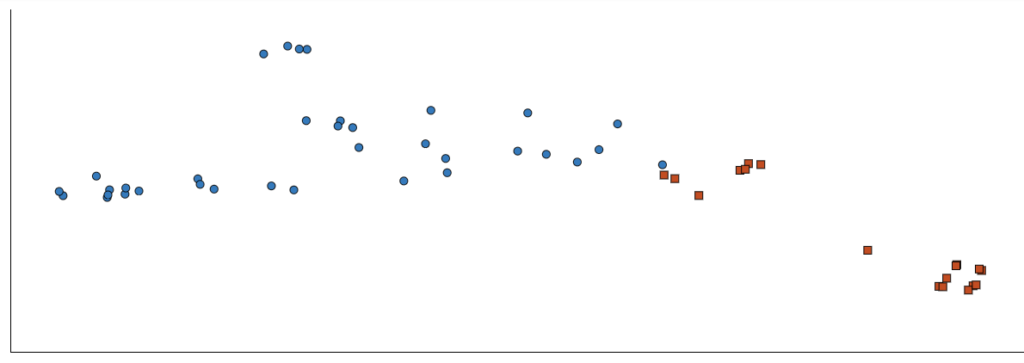
By clicking the “Run” option, you will be able to run the analysis on the given dataset. I have run a basic analysis on my dataset. Now, I will show you how the output of the analysis can be better understood and utilised to the best extent. This is the initial output of my first run with two clusters.
Please note that GDSL does not tell you what the y-axis or x-axis is but there are ways you can understand the output in a more comprehensive manner. The very first thing to do is to just manually compare and contrast the data points available in the two clusters. I attempted to do this with the clusters I generated. I saw that cluster 2 (the orange cluster) contained more philosophical works whereas cluster 1 (blue cluster) contained more general works such as history, literature and news. This gives me a general idea of what the x-axis (or perhaps the y-axis) might mean for this graph. The higher the x value, the more philosophical the work might be.
Another good way to understand the output is to increase the number of clusters. You can change the cleaning configuration and No. of clusters of the tool by going to Document Clustering > Tool Setup (grey toolbar on left) > Cleaning Configuration/Number of Clusters. Below is the setup I used for my second test run. Rather than using 2 clusters only, I used 3 clusters.
The graph generated for 3 clusters looked like this:
Given this cluster, I aimed to find out the main difference between the three clusters. I found out that the third cluster in this graph only included magazines. The second cluster also included magazines (but more of an academic nature rather than literati nature).
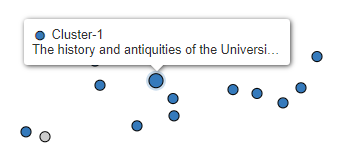
In addition to this, you can also revise your dataset and search for terms in them. This can also help you find out what are the classifications being made in the clusters. It would not always be obvious what the cluster contains but a close look and analysis can provide more information.
This year (2021/22), my third and last year as a DHA, I have worked as a senior DHA to assist other student co-workers. Having more flexibility, I was also able to get myself exposed to various new tools—including FTP server, CVS import, pivot tables in Google Sheets, 3D model viewer, Storymap, Podcast editing, and Canva—and to take advantage of my skills and experiences in projects even beyond the DHA.
I was fortunate enough to get involved in several history projects using digital tools throughout this year. As I mentioned in my introduction post, I’ve always been interested in historical narrative-telling with ArcGIS StoryMap and ArcGIS Mapping. Using my skills and experience in digital humanities, I was able to take an initiative in brainstorming and creating digital presentations for two history projects respectively in HIST316 Presenting America’s Founding and HIST200 Historians for Hire. In the former class, my group built a story map Mapping the Congregants of Color at Old South Church telling a life story of one of the congregants of color at Old South Church in revolutionary era Boston. With GIS mapping tools, we attempted to interpret and visually present the understudied individual’s emotional experience of the time.
Mapping the Congregants of Color at Old South Church
Learning from Place: Honest Stories of the Land and People
In the latter project, my group also created a story map Learning from Place: Honest Stories of the Land and People aiming to raise the spatial, historical awareness of the land and the Indigenous people on the land where Carleton College now occupies. It was a great experience to build digital story maps from scratch and to push myself to think about the effective ways of storytelling while trying to make them thought-provoking and facilitative in the audience’s learning and reflection experience.
I feel grateful for my supervisors who gave me this wonderful opportunity and for my co-student workers who always inspired me throughout the year!
I’ve spent a lot of this term cleaning up the Carleton Guide to Medieval Rome from Reason site. While I have worked a decent amount with Omeka before, this project has given me a whole new level of appreciation for how much detailed, meticulous work goes into making these types of websites look their best. And while there have been a few times I got frustrated or confused (such as when a random coverage field box would not disappear), it has been really rewarding to see it slowly start to look better and more uniform and to become truly familiar with a collection. Because it turns out that I like spreadsheets. I like metadata. I enjoy the behind-the-scenes work needed to help make projects presentable to a public audience.
I’m graduating soon, so for me I think what I’ve appreciated the most this term, through all the projects I’ve worked on, is the opportunity to cement for myself that I do truly enjoy this type of work. While graduation is still scary, at least now I feel a lot more comfortable and confident going into my post-graduation plans. (Plus writing the Star-Bellied Sneetches Twine story example with Karah was such a fun break from my endless comps research!)
Early on in the term I spent a couple weeks working on class handouts for PSYC 384, providing examples for ways the students can reimagine the class’s usual final project to be a digital endeavor. When the class was in person, students would create games that demonstrate how prejudice works and ways to combat bias.
I had so much fun coming up with different ways of creating digital game boards and playing with online tools as we made examples for the PSYC class. I learned how to use Twine, a site where you can build choose-your-own-adventure stories. Marcella and I enjoyed writing a Twine story example about Star-Bellied Sneetches so that it would fit into the class theme of reducing prejudice. We were really able to play around and be creative with this project, which goes to show just how many possibilities the digital humanities can offer classroom settings and beyond.
I particularly enjoyed being a visitor in the PSYC 384 class because we were able to describe all the work we did and share the ideas we had come up with for games they could make. It was also great to simply see the faces of everyone who would be using the materials Marcella and I put together for the class. It’s the smaller things like this that I am appreciating this term.
I learned a lot this term from concrete skills like website building and how to add plug ins on WordPress, to more abstract concepts such as how much information companies like Facebook have about me or how to effectively work and communicate all online. For the sake of this short reflection though, I’d like to focus on my personal growth and increasing interest in digital humanities.
One thing I have loved about learning new digital skills is how much it has demystified the digital world for me, particularly code. As someone with a lot of friends in CS, that world has always rather terrified me, and it has been hard to get past the view of people working in coding languages as wizards who go clickity clack on their computers and magically make things happen. I’ve always respected it, but firmly believed I could never do anything like that. While I have certainly not done any real coding for this job, learning more digital skills and having coding language pop up in small, manageable, understandable ways has really helped build my confidence as well as make computers seem a lot less scary. And the more I realize just how doable using digital tools for humanities projects is, the more I want to share with my peers in the humanities who have perhaps not yet drunk the Kool-Aid. I want to share the knowledge that we shouldn’t be scared of the digital world and should instead embrace it as a helpful resource and a good way to bring the subjects we love into the 21st century while potentially reaching a wider audience.
In addition, getting to work more with metadata this term has helped solidify my desire to continue my education in library sciences after I graduate. It’s been posted here before, but having worked a lot this past year with Omeka, this meme felt appropriate and made me laugh:
I had a great term, and I’m looking forward to winter!
During the fall term 2019, I’ve been working on the WordPress site and updating the Carleton DHA page.
In the former project, collaborating with professors from the Classics Department, I created CHIANTI site, a WordPress site. To add and organize various contents, I used several plugins: Elementor to organize the content pages, Shortcodes and List category posts to order posts sorted by categories on a page, Document Embedder to convert language learning sources to be downloadable, Smart Slider to use a video carousel on the student portal page, and Pods Admin to create a submission form for faculties.
French page for the instructors (The var on the left shows the code for showing posts sorted by tags)
In the course of arranging and refining the site, I realized some tips which would be helpful when creating websites at another time. I’ll write them down for future use.
Clarify the audience and objects of the website.
When you get stuck, google for the troubleshooting first. There is maybe somebody who is in the same situation and already asked similar questions.
Be careful about the consistency – theme colors, fonts, font sizes……
When you are not sure which plugin to use, see their review, download numbers, the latest update date.
If you create a website and then yield control over it to the third party, make sure to create a concise and easy to follow instructional document. (preferably with some screenshots as needed) This is actually a great way to keep information in one place, such as the theme colors and fonts.
Finally, although there is a lot more to mention, communicating with partners/clients is crucial to improve the website closer to what they expect.
Regarding updating the Carleton DHA page, with permission to access and edit the page, I mainly updated the DH members for this year and the past projects. Updating past projects especially required some important things to keep in mind: 1) Use visually eye-catching screenshots of the project, 2) Check the copyright of the image within the screenshots, 3) Avoid controversial contents/images publishing on the web, 4) Make sure that private information is hidden.
As you’ve seen, I spent most of the time working with WordPress. For the next term, I hope I’ll be working with other types of digital tools.
One of the projects I’ve been working on this year has been a textual analysis of the fifteenth-century London Chronicles for an English professor’s research. The professor hoped to identify and isolate place names in the text (such as London Bridge, Sussex, etc.) and make a map of all the data. This is where the Digital Humanities team came in: what software and digital tools could we use to extract this data and display it in an insight way?
The first tool we examined was Voyant, an online textual analysis tool that creates data visualizations. We uploaded a PDF of the London Chronicles to Voyant and played around with the website to see how it worked and determine whether it was effective.
A screenshot of the London Chronicles data visualization in Voyant
While Voyant was great for analyzing macro data sets and getting a holistic view of the text, it was rather ineffective for gathering specific iterations of place names and appeared no better than manual close reading for this purpose. One of the other problems we encountered were the variations in medieval spelling; for example, Voyant created a separate category for “London” and “Londan” even if they referred to the same place.
We then turned to a different tool to help map our place names: Edinburgh Geoparser. Geoparser created a wonderful map of the place names. However, it was unable to quantify the number of times a place name appears or arrange the place names in order of frequency. Thus, it was great for visualizing the places but not ideal for textual analysis.
The map of the London Chronicles created by Edinburgh Geoparser
Finally, after testing these different softwares, we stumbled upon a Gazetteer of Early Modern Europe which contained a list of place names, their spelling variants, and their location. We collaborated with a member of the Data Squad, a local Carleton organization dedicated to organizing data, to produce a program that would cross-reference The London Chronicles PDF with an XML of this data. In this manner, we would be able to get a reliable count of place names in the text that included their spelling variants.
The Early Modern London Gazetteer
This process has taught me that Digital Humanities is a lot of trial and error. In doing this research, I’ve learned there might not be one perfect tool for a project, but combining different resources and collaborating with others allowed me to find an innovative solution. This experimentation and sharing of ideas and research is vital to the work we do as Digital Humanities Associates.
I enjoyed my training as an DHA and am excited for the upcoming year. The interdisciplinary nature makes the field extremely broad, requiring us to take a #multifacetedapproach. I really enjoy this dynamic aspect about digital humanities. As a result, I made the following meme.
I am excited to learn more and expand my horizons further in my work as a DHA!